AI automation, in one sentence, is this: a system that takes a repetitive job off your team’s plate and does it the same way every time, without someone having to remember, copy, or chase it.
That is the whole idea. It is not magic, and it is not a robot that runs your business while you watch. It is a practical way to stop losing time and leads to work that a person should not have to repeat all day.
I am Muhammad Zain, based in Multan, Pakistan, and I build AI automation for founders, agencies, and service businesses. I have worked with more than 50 clients and built more than 100 workflows, and the pattern is almost always the same: the business is not short of effort. It is short of follow-through on the boring, repeatable steps.
Start with the problem, not the tool
Most people start by asking which tool to buy. That is the wrong first question. A tool does not fix a messy process. It just makes the mess move faster.
Start instead with a simple question: what work do we do over and over, in the same order, with the same result? If the answer is clear, automation can probably help. If the work changes every time and needs judgement, a human should still own it.
A good system has a trigger, a set of steps, and a clear result. A new lead comes in, the system routes it, sends the right follow-up, and updates the record. A new invoice arrives, the system reads it, checks it, and files it. Nobody has to remember the next step, because the system does not forget.
What AI automation replaces
It replaces the middle work: copying, sorting, reminding, routing, and checking. It does not replace the conversation, the decision, or the relationship. Think of it as a reliable assistant for the tasks your team already knows how to do, but does not have time to do perfectly every time.
Lead routing is a clear example. In one client system I built, a new lead used to wait about 18 minutes before anyone followed up. After routing was automated, that wait fell to 42 seconds, and the show rate rose by 38 percent across 11 sub-accounts. The system did not sell anything. It simply made sure the right person saw the right lead at the right time.
Invoice work tells the same story. An Invoice OCR system I built reads more than 200 invoices a week at 98.6 percent accuracy, in about 6 seconds per invoice. Before that, the same work was slow, manual, and easy to get wrong at the end of a long day. Automation did not change what the business charged. It removed the delay and the typing errors between receiving an invoice and recording it.
What AI automation does not do
It does not fix a bad offer. If nobody wants the service, faster follow-up will not save it. It does not replace trust, either. Customers still want to talk to a real person before they spend real money, especially on a larger project.
It also does not work well when the rules are unclear. If every lead is handled differently, if nobody agrees on what counts as a good lead, or if the data is a mess, automation will faithfully repeat that confusion. Clean up the decision first, then automate it.
And it does not mean you can stop checking. A good system still needs a human to review the edge cases, handle the unusual request, and step in when something looks wrong. Automation should reduce your workload, not remove your judgement.
The 3-part test before you buy
Before you pay for any system, run this short test. First, can you name the exact job it will do, in one sentence? If you cannot, you are buying a demo, not a solution.
Second, can you measure the result? Hours saved, leads answered faster, fewer missed calls, or fewer errors are all measurable. If the only promise is that it feels modern, walk away.
Third, what happens when it goes wrong? Who sees the error, who fixes it, and what does the customer experience in the meantime? A system with no fallback is not finished, no matter how impressive the demo looks.
If a system passes all three, it is worth a serious conversation. If it fails even one, keep looking or start smaller.
A worked example: from inbox chaos to a clear next step
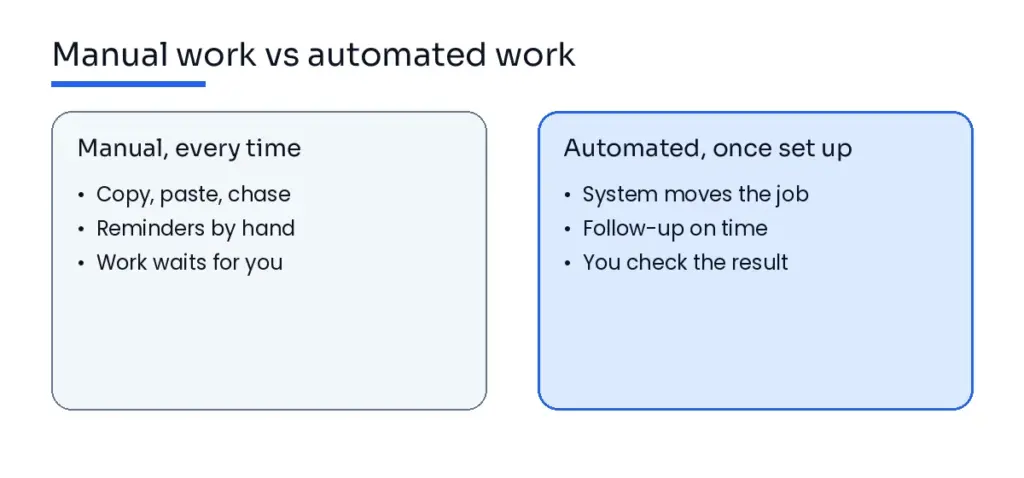
Picture a small service business. Leads arrive by form, WhatsApp, and phone. Some get answered quickly, some sit overnight, and a few are never answered at all. Nobody is lazy. There is just no single place where every lead lands, and no rule for who follows up first.
With automation, every lead lands in one place, is routed to the right person or sub-account, and gets an immediate acknowledgement. Follow-up is scheduled, not remembered. The owner can finally see which leads were answered, which are waiting, and where the leaks are. That visibility is often worth as much as the time saved.
That is the same pattern behind the lead routing result above: 18 minutes down to 42 seconds, and a 38 percent higher show rate. The win was not a clever tool. It was a clear process, done on time, every time.
Frequently asked questions
Is AI automation the same as a chatbot?
No. A chatbot answers questions. Automation does work: it moves information, triggers follow-ups, updates records, and connects your tools. A chatbot can be one part of a system, but on its own it is not automation.
Do I need a big team or a big budget to start?
No. Start with one repetitive job that costs hours or loses leads. Simple systems start from $500, while more complex systems are typically in the $2,000 to $10,000+ range, depending on scope. The right size is the one that solves a real problem without adding new complexity.
Will automation replace my team?
In my experience, it replaces tasks, not people. Your team stops doing copy-and-paste work and spends more time on conversations, decisions, and service. The businesses that get the most from automation are the ones that free their people to do the work only people can do.
Your next step
If you are not sure where to start, look at the work your team repeats every week and ask which step, if missed, costs you a lead or an hour. That is your first candidate. You can also read more about how I approach this for businesses on the For Businesses page and the AI Automation service page.
Want help deciding what to automate first? Book a Demo on WhatsApp, or Contact me through the site. Tell me the one job that eats your week, and we will talk honestly about whether automation is the right fix.