
An agentic AI system is not a chatbot that answers questions. It is a system that plans, uses tools, and finishes tasks.
That difference matters. A chatbot waits for you to ask something, then replies. An agent is given a goal, works out the steps, takes action, checks the result, and keeps going until the job is done or it needs a human.
I am Muhammad Zain, based in Multan, Pakistan, and I build these systems for founders, agencies, and service businesses. I have worked with more than 50 clients and built more than 100 workflows, and the best agents are usually the simplest ones: clear goal, clear tools, clear limits.
Chatbot vs agent: a simple test
Ask yourself one question: after the reply, does anything happen? If the answer is no, you are looking at a chatbot. If the system books, updates, sends, routes, or resolves something, you are looking at an agent.
A chatbot can be helpful. It can answer a common question at midnight. But it does not follow up, it does not check your calendar, and it does not fix the problem behind the question. An agent is built to do the next step, not just describe it.
Part 1: The planner
The planner is the part that breaks a goal into steps. If the goal is to resolve a support enquiry, the planner might decide to first find the customer, then check the order, then look for the answer, then reply, then record what happened.
A good planner does not guess wildly. It follows rules you set: what to try first, what to check before acting, and when to stop and hand over to a human. Without a planner, you get a system that replies confidently but does nothing useful.
Part 2: The tools
Tools are what let the agent act. A tool might search your help articles, look up a booking, update a record, send a message, or create a ticket. The agent itself does not magically know your business. It uses the tools you connect, within the limits you set.
This is why tool choice matters more than model choice. An agent with the right tools and clear permission can do real work. An agent with no tools can only talk about work. Before you buy, ask exactly which tools it will use, and what it is never allowed to do.
Part 3: Memory and rules
Memory is how the agent remembers what matters across a conversation and across tasks: who the customer is, what was already tried, and what the business has decided. Rules are the guardrails around that memory: never share private details, never promise a refund it cannot approve, and always escalate when it is unsure.
Good memory makes the system feel helpful instead of repetitive. Good rules make it safe. You need both. Memory without rules can go too far. Rules without memory force the customer to repeat themselves, which defeats the point.
A worked example: Support Copilot
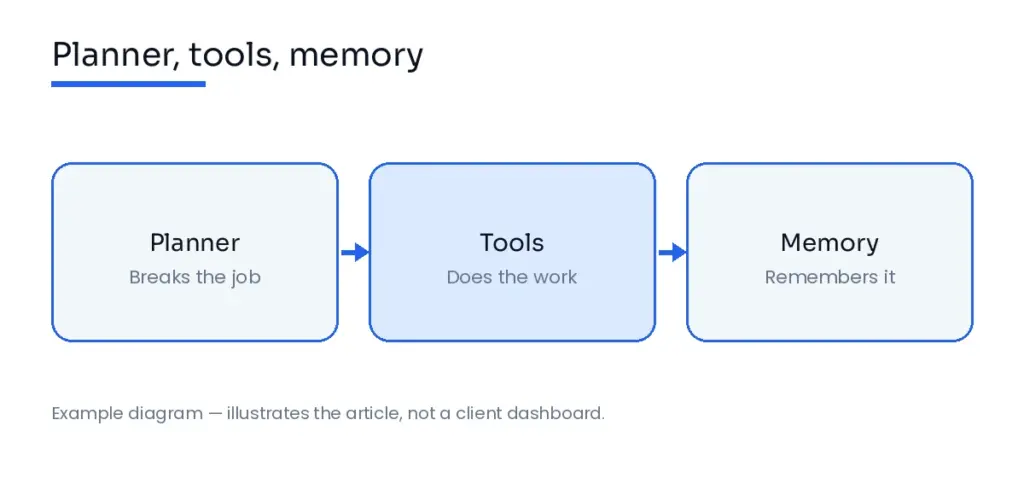
Take a support system I built, called Support Copilot. A customer writes in with a problem. The planner works out what kind of problem it is. The tools check the relevant record and help articles. The system then resolves the straightforward cases itself and passes the rest to a human, with the context already gathered.
The results were clear: 68 percent of enquiries were auto-resolved, customer satisfaction stayed at 4.7 out of 5, and handle time fell by 54 percent. The point was not to remove humans. It was to remove the repeat work so humans could focus on the cases that actually needed them.
Where agents fail
Agents fail when the goal is vague. If you tell a system to improve customer happiness, it will not know what to do. If you tell it to resolve password and booking questions using these articles, and escalate refunds, it has a job it can actually do.
They also fail when they are given too much freedom. An agent that can send messages, change records, and promise outcomes without checks will eventually make a mistake that a human would have caught. The fix is not less ambition. It is better limits: approve the big actions, log everything, and make handover easy.
Finally, agents fail when nobody watches the results. Check what the agent resolved, what it escalated, and where customers got stuck. A system that is never reviewed is not automation. It is hope.
Frequently asked questions
Is an agentic AI system just a smarter chatbot?
No. A chatbot answers. An agent plans, uses tools, and completes tasks, then checks whether the task actually worked. That ability to act, not just reply, is the whole difference.
Do I need to replace my current tools?
Usually not. A good agent connects to the tools you already use, such as your booking system, inbox, or CRM. If a vendor says you must replace everything to start, ask what problem that solves for you, not for them.
How do I keep an agent safe?
Set clear rules, limit what it can change, log its actions, and give customers a simple way to reach a human. Start with low-risk tasks, review the results, and widen its role only after it earns trust.
Your next step
If you want an agent, start by writing down one job it should finish, the tools it will need, and the point where it must hand over to a human. That short brief will tell you more than any demo. You can read more about this kind of system on the Agentic AI Systems service page.
Want help designing one for your business? Book a Demo on WhatsApp, or Contact me through the site. Tell me the task you wish would just get done, and we will talk about whether an agent is the right way to do it.