
If you could automate only one thing in your business, what should it be? My answer is simple: automate the work that is already losing you money.
Not the fanciest work. Not the work you saw in a demo. The work that quietly costs you hours, leads, or bookings every single week.
I am Muhammad Zain, from Multan, Pakistan. I have built more than 100 workflows for more than 50 clients, and I see the same mistake again and again: a busy owner tries to automate everything at once, gets overwhelmed, and ends up automating nothing well.
Start with the leak
A leak is a place where value escapes because a step is slow, manual, or forgotten. You do not need a dashboard to find it. Ask your team a simple question: what do we keep meaning to do, but keep missing?
Usually the answer is not hard to find. It is the follow-up that goes out a day late, the enquiry that sits in an inbox overnight, or the booking that never gets confirmed because nobody had time to reply.
Three places where leaks hide
First, missed calls and messages. When you are busy serving a customer, you cannot answer every call. The caller does not wait politely. They call the next business. A missed call is often a lost lead, not just a missed conversation.
Second, slow follow-up. A lead who hears back in two minutes feels wanted. A lead who hears back the next day has already moved on. Speed matters more than a perfect message. A short, honest reply now beats a polished reply tomorrow.
Third, manual chasing and booking. Reminders, confirmations, reschedules, and no-shows eat hours every week. When one person has to remember all of it, something will slip. And when it slips, it usually costs a booking, not just a few minutes.
One system first, then connected systems
Start with one system that fixes your biggest leak. Prove it works. Then connect the next piece. That is how a real automation setup grows, step by step, instead of collapsing under its own complexity.
Think of it in stages. A Starter setup fixes the first leak, such as missed-call follow-up or lead capture. A Growth setup connects more of the journey, from first enquiry to booked appointment. A Scale setup ties several systems together so leads, bookings, and follow-ups run as one process.
You do not need to jump to the largest stage. You need to fix the leak that hurts most, then build on a system your team already trusts.
A worked example: missed call to booked appointment
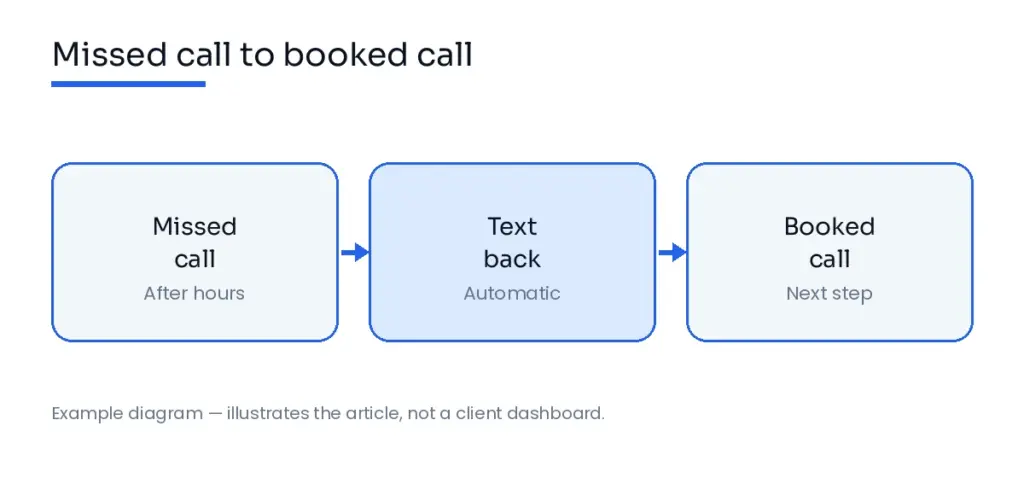
Here is a simple chain that works for many service businesses. A customer calls while the team is busy. The call is missed, but the system immediately sends a text back: sorry we missed you, how can we help?
The reply is captured, the lead is routed to the right person, and a follow-up is scheduled. If the customer wants to book, the conversation moves toward a booking instead of sitting in a missed-call list nobody checks.
This is the same kind of after-hours capture behind a WhatsApp Concierge system I built, which captured 100 percent of after-hours enquiries and lifted bookings by 27 percent. The technology was not complicated. The win was that no enquiry was left waiting until morning, when the customer had already chosen someone else.
Mistakes to avoid
Do not automate five things at once. Pick one leak, fix it properly, and watch it for a week. If it saves time or wins bookings, you have proof. If it does not, you have learned something cheaply.
Do not automate a process nobody understands. Write down the steps first: what happens, who owns it, and what a good result looks like. Automation copies your process. Make sure it is a process worth copying.
Do not hide behind automation. Customers should always be able to reach a real person. The system should speed up the first reply and the follow-up, not trap people in a loop with no way out.
Frequently asked questions
How do I choose my first automation?
Look for work that is repetitive, time-sensitive, and costly when missed. Missed calls, slow lead follow-up, and booking reminders are common starting points because the cost of delay is easy to see.
How long should the first automation take to show a result?
Faster than most people expect, if the job is narrow. When the system answers missed calls and routes leads at once, the change shows up in the first week: fewer unanswered enquiries and faster replies. Judge it by leads answered and bookings kept, not by how clever it looks.
Should I automate sales, support, or admin first?
Automate whichever one is leaking most. For most busy service businesses, that is the front door: enquiries, calls, and bookings. Fix the front door first, then work inward to support and admin.
Your next step
This article is a longer companion to my guide, What to Automate First. Read that guide for a shorter checklist, then come back here when you are ready to build the first system properly.
Still not sure where your biggest leak is? Book a Demo on WhatsApp, or Contact me through the site. Tell me what keeps slipping through the cracks, and we will start with that one job.